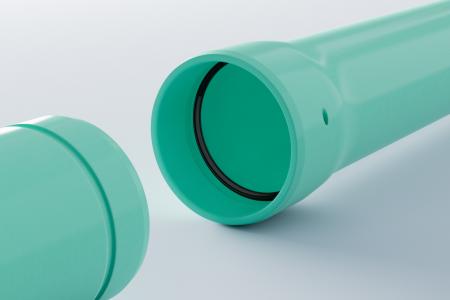
Work began in June 2012 after two years of design development with Madden Phillips Construction Inc. handling excavations and connections. As general contractor, Madden Phillips Construction subcontracted the directional boring to Trenchless Flowline who recommended using Westlake pipe based upon their experience of installing more than 40,000 feet of such pipe, to very tight grades in a variety of soils. The city approved the subcontractor’s recommendation to use 12-inch Certa-Flo PVC gravity sewer pipe manufactured by Westlake Pipe & Fittings. The Certa-Flo restrained joint integral bell (RJIB) pipe provides a restrained joint by utilizing precision-machined grooves on the pipe and in the integral bell that when aligned allows a spline to be inserted, resulting in a fully circumferential restrained joint, locking the pipes together; a flexible elastomeric gasket in the integral bell provided a hydraulic seal, which locks the pipe joints together. Certa-Flo pipe is available in 10-foot and 20-foot lengths and the light green color makes the pipe easy to see during televised sewer inspections.
“The shorter joint option was a big advantage,” says Ted Dimitroff, president of Trenchless Flowline, who has installed the pipe as deep as 42 feet on previous ArrowBore projects. “We used the 10-foot joints because it cost too much to dig the deep pits at each manhole to accommodate the 20-foot joints. Certa-Flo is the only PVC pipe
we’ve found that offers pullback strength and holds up to our push method without over-belling. Westlake Pipe has never failed us in more than 13 years of installations.”
To stay on-grade, the process included boring vertically at 30-foot intervals, the 16-inch holes let engineers verify grade accuracy during, rather than after, installation — a key improvement over traditional directional boring. Pilot stem depth was checked at each hole with a laser sight and measuring rod dropped into the hole. If the drilling head was off-grade, it was instantaneously realigned with another rod that’s inserted down the hole and hooked onto the drill’s pilot stem. The sight holes also served as slurry outlets with all slurry forced up vertically, not into the pits, by the pipe during pullback. The process uses back reamers to widen the bore a quarter-inch larger than the pipe’s outside diameter. This prevents the pipe from floating within annulus space around the pipe, another feature that contributes to maintaining on-grade installation.
Trenchless Flowline’s five-member crew used a standard Ditch Witch JT4020 directional drill and a Ditch Witch JT2720 vertical HDD rig modified to drill the sight relief holes along the bore path and establish line and grade coordinates; these rigs, converted to vertical drilling for use with the company’s technologies, are rubber-track, lightweight, and can drill up to a 48-inch vertical hole very quickly. The crew was also supported by electronic locating and monitoring devices.
The crew then used the JT4020 drill (40,000 pounds of pullback; 4,000 pounds of torque) to make a series of five on-grade bores at depths ranging from 10-22 feet through dry river bottom silt, with some areas of sugar sand and sandstone. The hard-packed soils created a challenge, but with the help of customized drilling fluids and a Ditch Witch MM9 mud-mixing system, the crew overcame this obstacle.
During pullback, crew members followed behind with a Vac-Tron Mini Combo 855SDT trailer-mounted sewer jetter to remove slurry from the sight relief holes. A total of 1,900 feet of Certa-Flo pipe was lowered into the receiving pits with an excavator and assembled, joint-by-joint, during pullback.
Trenchless Flowline completed the gravity sewer line in August 2012, meeting the open-cut specification of line and grade with only minimal disturbance to the neighborhood. “Everything worked out well,” Mills commented. “I don’t think we could have gotten any more on-grade with a different method. And the (Certa-Flo) pipe was great, it held up well in a hard drag through dense soil and didn’t pull apart or elongate.”