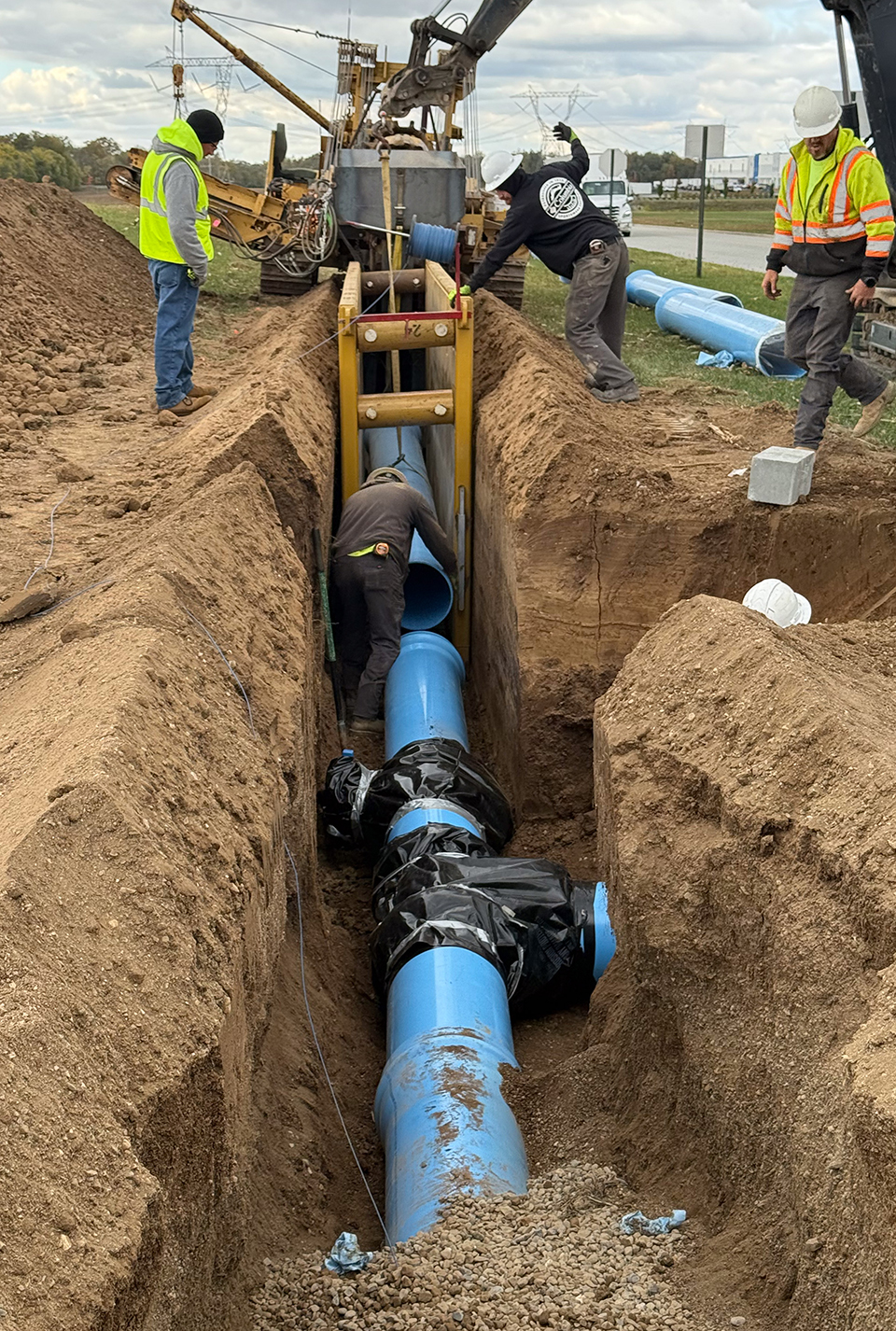
Unique Trench and Trenchless Approach Using Certa-Lok® and PVCO Delivers Reliable Water Infrastructure for Wapakoneta, Ohio

The City of Wapakoneta, Ohio, faced the challenge of expanding its water infrastructure to support a new water tower and high-demand industrial users, all while navigating sensitive environmental crossings in a rural-industrial mix.

Wapakoneta OH 1

Location

Wapakoneta , OH

Project Owner

City of Wapakoneta

Contractor

Miller Contracting

Engineer

Choice One Engineering

Market Segments

  • Municipal

Challenge

The City of Wapakoneta needed to enhance its water storage and distribution system to serve an expanding industrial park and local businesses. This involved building a new water tower for additional storage and reserves, particularly to support water reserves needed in case of issues at the water treatment plant.

In addition, the city is experiencing rapid industrial development and planning for continued expansion within the Industrial Park, including a future extension of the Pratt Paper facility along Leon Pratt Drive. As a result, the city anticipates a significant increase in water demand, from approximately 2.4 million gallons per day (MGD) to 5.0 MGD, primarily driven by industrial growth. To prepare for this increase, the city recently upgraded its water treatment plant and conducted a comprehensive water system study to identify required infrastructure improvements. The study determined the need for a new 3.0-million-gallon water tower within the Industrial Park, along with multiple transmission main extensions to improve system redundancy, fire flow capacity, and overall performance.

The project required installing large-diameter water mains to loop around the area’s industrial section, ensuring reliable supply to facilities that consume significant volumes of water, some requiring a ton of water to support operations—where any shutdown could cause major operational headaches.

Application

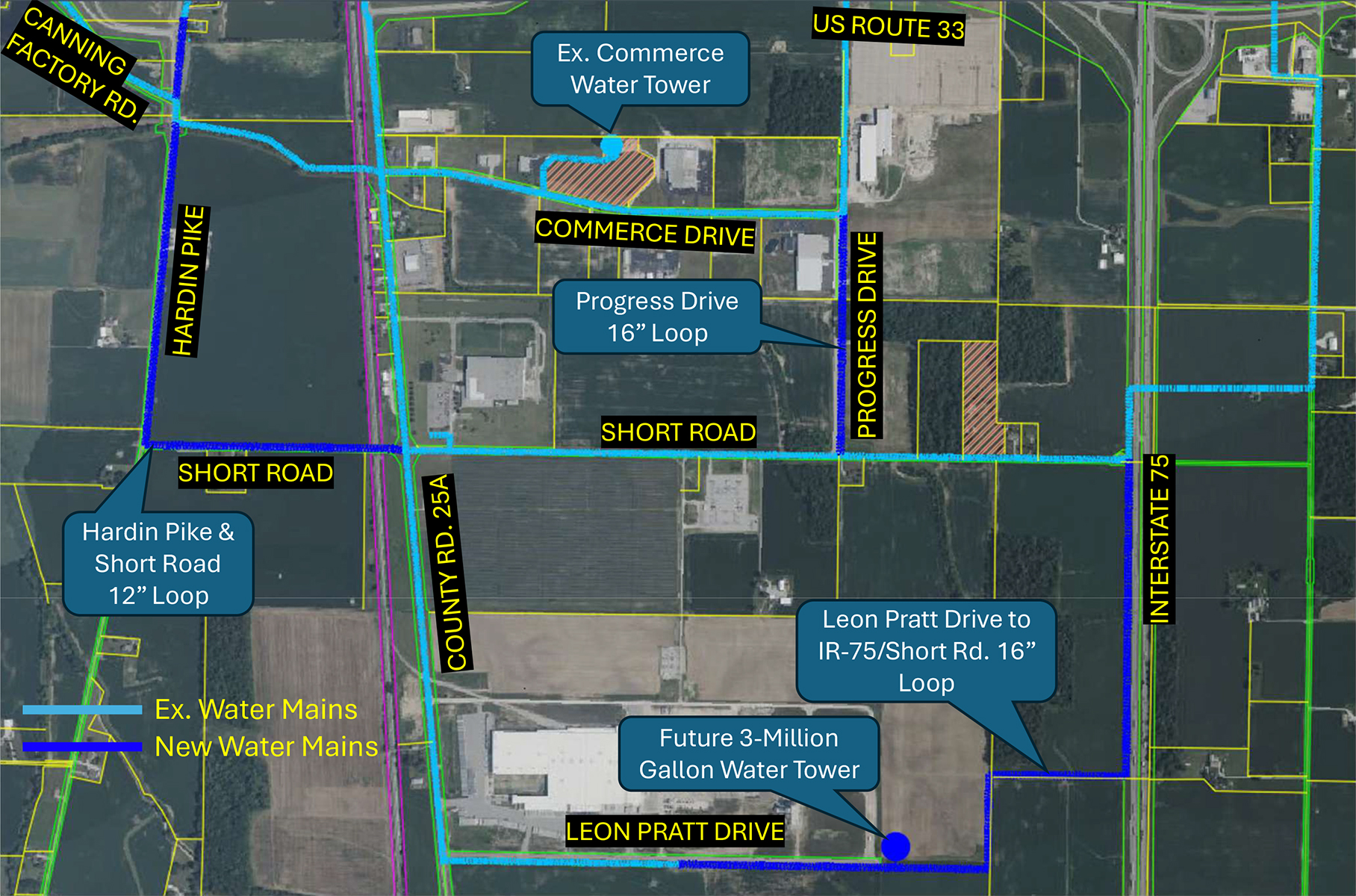
This project involved the installation of approximately 16,000 feet of new water main extensions recommended by the city’s water system study throughout key areas of the Industrial Park and surrounding roadways. Installation locations for the water main included Progress Drive, Short Road, Hardin Pike Road, Leon Pratt Drive, and through farm fields northeast of Leon Pratt Drive.

  • The system was designed as a series of strategic loops to improve redundancy and performance:
    Hardin Pike and Short Road 12-inch loop: Installed to provide a secondary feed from the city’s water treatment plant to the Industrial Park and broader system. This loop also tied into an existing dead-end main on Hardin Pike, which crosses north of US Route 33, creating a redundant feed to areas previously served by a single 16-inch transmission line along Canning Factory Road and County Road 25A.
  • Progress Drive 16-inch loop: Filled a critical gap between Short Road and Commerce Drive, providing a secondary feed to the existing Commerce Drive water tower while also enabling service access to undeveloped properties along Progress Drive.
  • Leon Pratt Drive loop (to Short Road/I-75 corridor): Designed to improve fire flow capacity and provide redundancy to an area previously experiencing fire flow limitations. This segment will also serve the future 3.0-million-gallon water tower planned along Leon Pratt Drive near the Pratt Paper facility and open access to undeveloped land between Leon Pratt Drive and Short Road.

The project conditions included a mix of rural and industrial terrain, with soil conditions consisting primarily of clay with sandy pockets. Environmental considerations included a waterway crossing within the project vicinity, requiring minimal disturbance. To address these varying conditions, the project incorporated a combination of installation methods:

  • Horizontal Directional Drilling (HDD) for environmentally sensitive crossings
  • Open-cut trenching for long, straight runs to maximize installation efficiency

Pipe products used included:

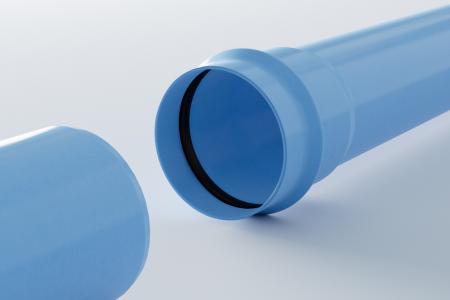
  • 440 LF of 6-inch C909 AquaMax® PVCO
  • 5,600 LF of 12-inch C909 AquaMax PVCO
  • 9,200 LF of 16-inch C909 AquaMax PVCO
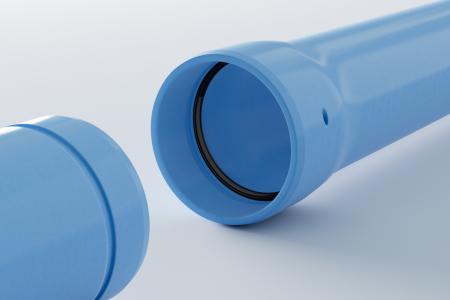
  • 260 LF of 12-inch C900 DR 18 Certa-Lok® RJIB
  • 340 LF of 16-inch C900 DR 18 Certa-Lok RJIB

The selection of materials aligned with the city’s existing standards, as C909 PVCO had become the preferred specification for larger diameter pipe, supporting consistency in system design and long-term performance. Westlake Pipe & Fittings’ products were chosen over alternatives for their cost-effectiveness, efficiency, and proven reliability in similar new installations. The mix of C909 AquaMax® PVCO and C900 Certa-Lok® restrained joint integral bell (RJIB) offered better performance. If not done with this approach, the project risked higher costs, longer timelines, business interruptions for industrial users, and environmental issues from traditional open cut across the entire site. This connected to existing C900 pipe and the future water tower as part of a new installation.

Solution

The contractor, Miller Contracting, in coordination with Choice One Engineering, executed the project using a phased approach tailored to both site conditions and the operational priorities of the city’s expanding Industrial Park. Construction took place across multiple key corridors, including Progress Drive, Short Road, Hardin Pike Road, Leon Pratt Drive, and through farm fields northeast of Leon Pratt Drive, each requiring a specific installation strategy based on terrain, environmental sensitivity, and system function.

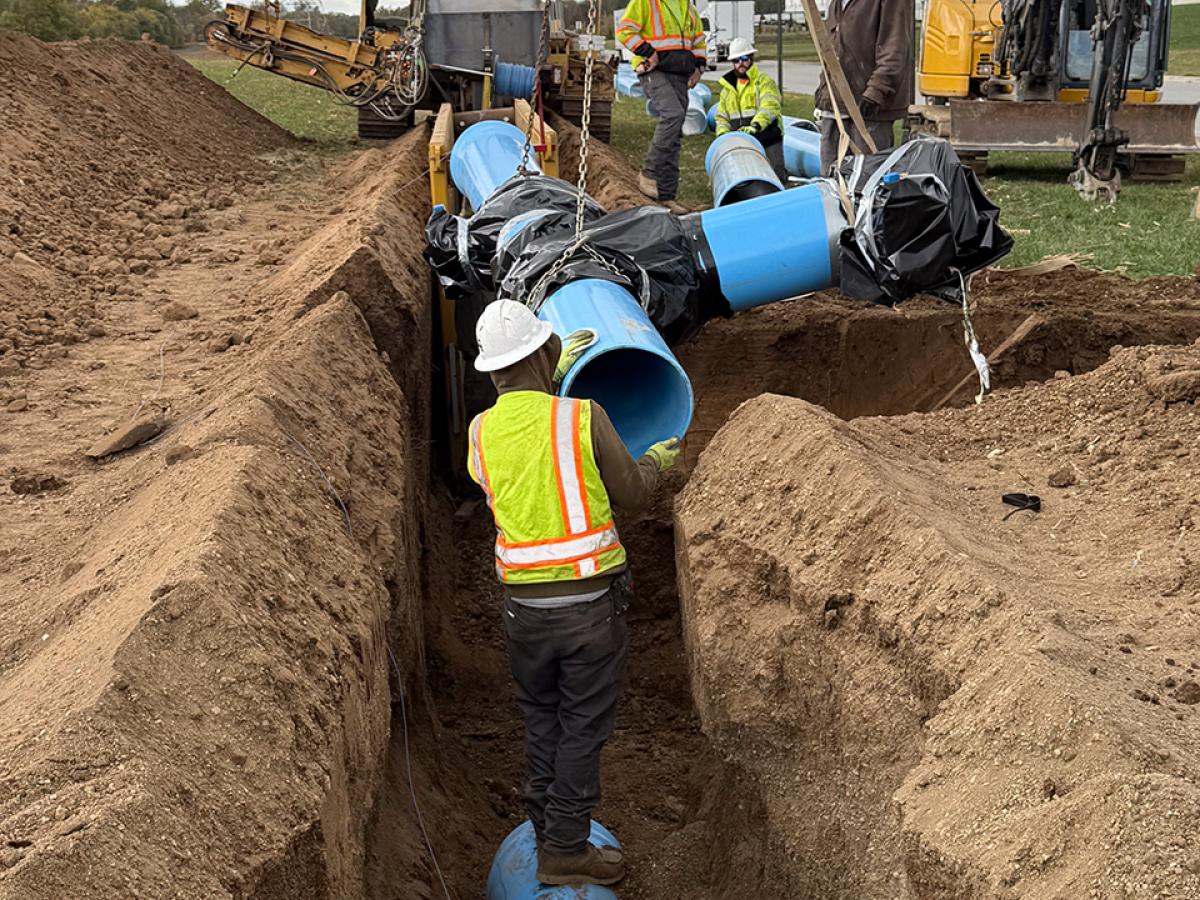
Phase 1 focused on preparation and critical infrastructure components. This included leveling areas where trench depths exceeded 7 feet, as well as installing bends, fittings, and appurtenances in advance of pipe installation. During this phase, HDD was used to complete two critical crossings beneath a waterway within the project vicinity, avoiding environmental disruption.

The HDD installations included:

  • Approximately 260 LF of 12-inch C900 DR18 Certa-Lok RJIB
  • Approximately 340 LF of 16-inch C900 DR18 Certa-Lok RJIB
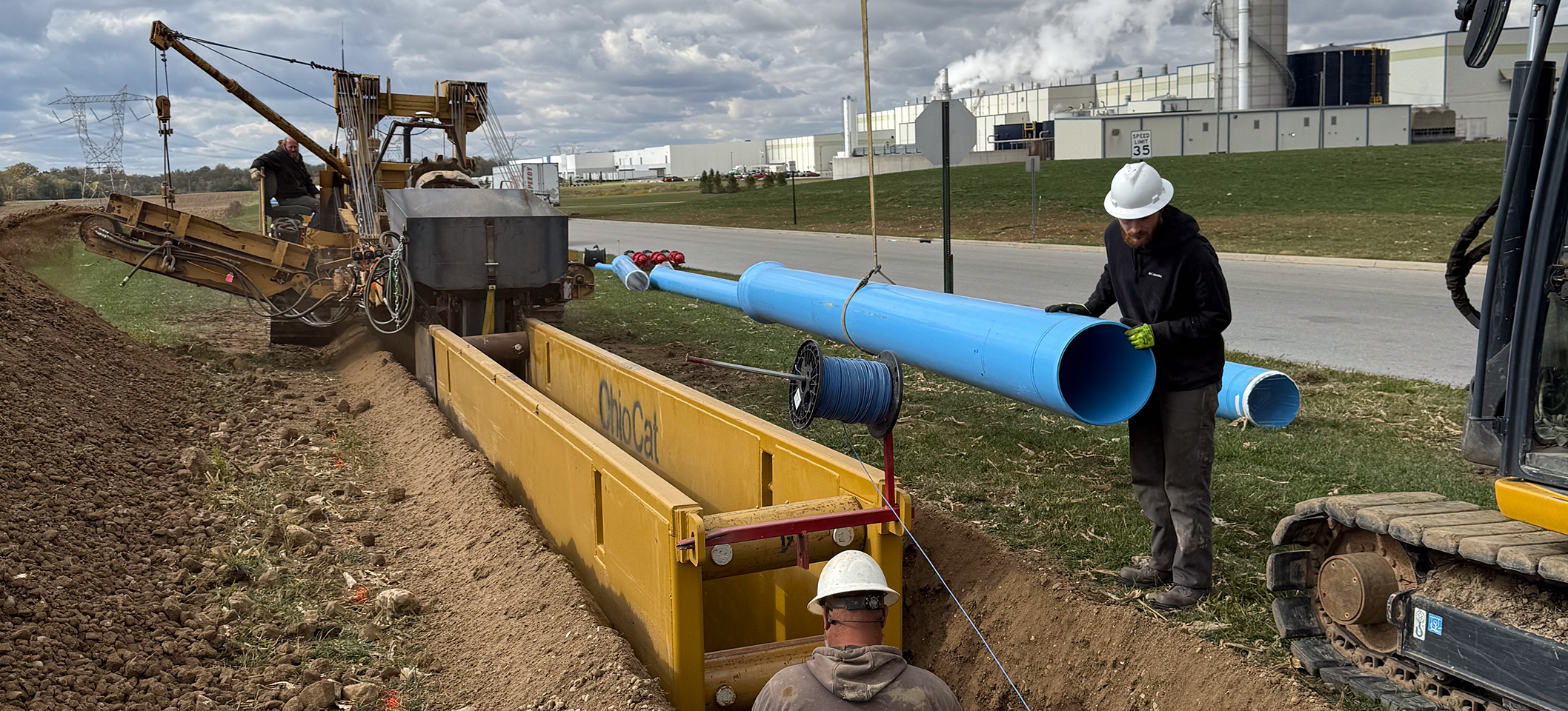
Due to site constraints and surrounding conditions, one of the bores was executed using a half-arc alignment, requiring fittings to transition the pipeline back to the appropriate elevation for tie-in with the rest of the system. This approach allowed the contractor to maintain alignment while adapting to field conditions without compromising performance.
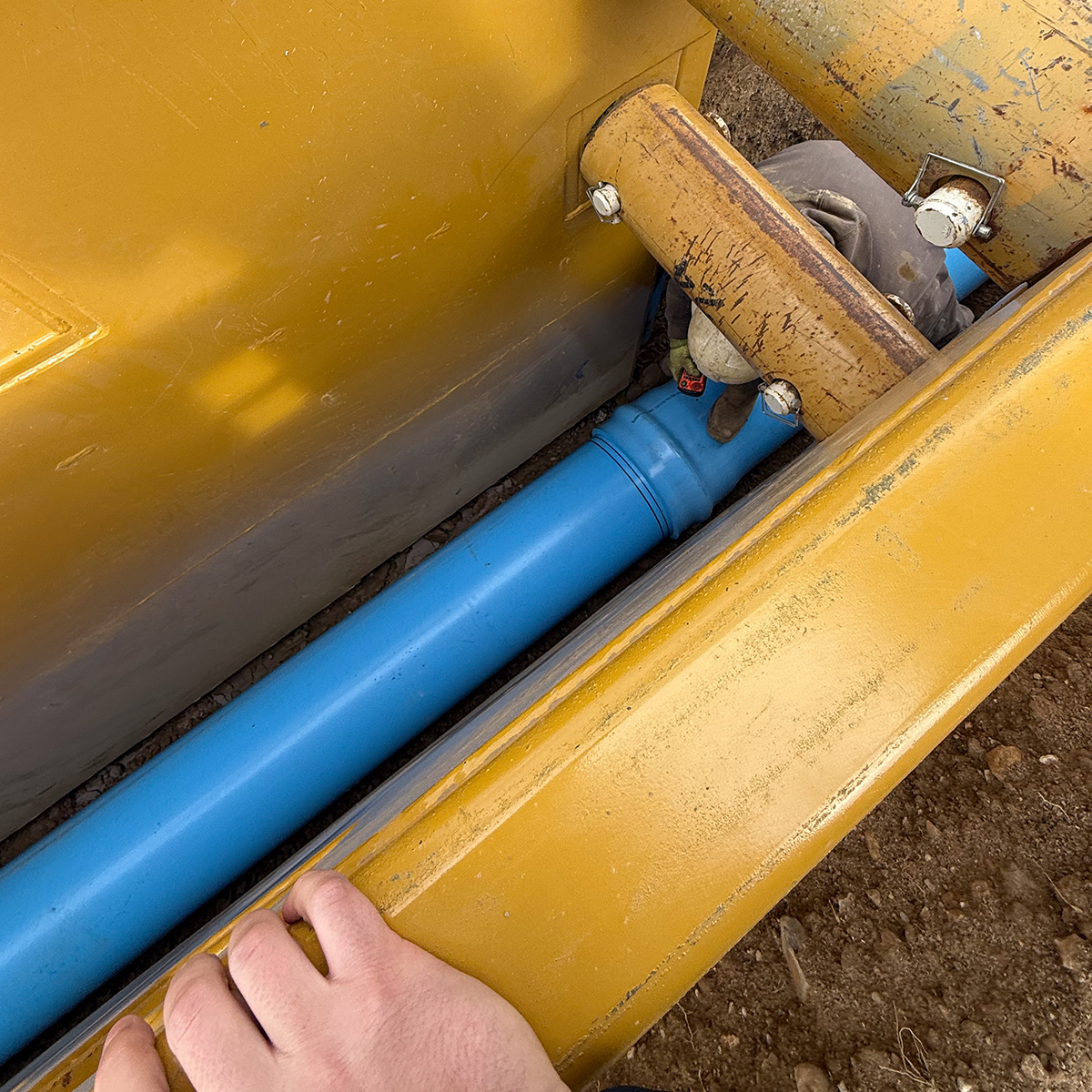
Phase 2 focused on high-efficiency installations of long, straight runs of water main, particularly along open corridors such as Progress Drive and sections connecting the Hardin Pike, Short Road, and Leon Pratt Drive loops. These segments were critical in delivering the system improvements identified in the city’s water study, including:

  • Establishing a secondary feed to the Industrial Park and broader system
  • Providing redundancy to areas previously served by a single transmission main
  • Improving fire flow capacity along Leon Pratt Drive, where limitations previously existed
  • Supporting the future 3.0-million-gallon water tower planned near the Pratt Paper facility along Leon Pratt Drive
  • Expanding service access to previously undeveloped properties within the Industrial Park

To maximize productivity during this phase, the contractor modified an existing trenching machine to simultaneously cut trench, place bedding, and bell pipe in a single pass. This innovation enabled installation rates of over 1,200 linear feet of 16-inch C909 PVCO pipe per day, significantly accelerating the schedule.
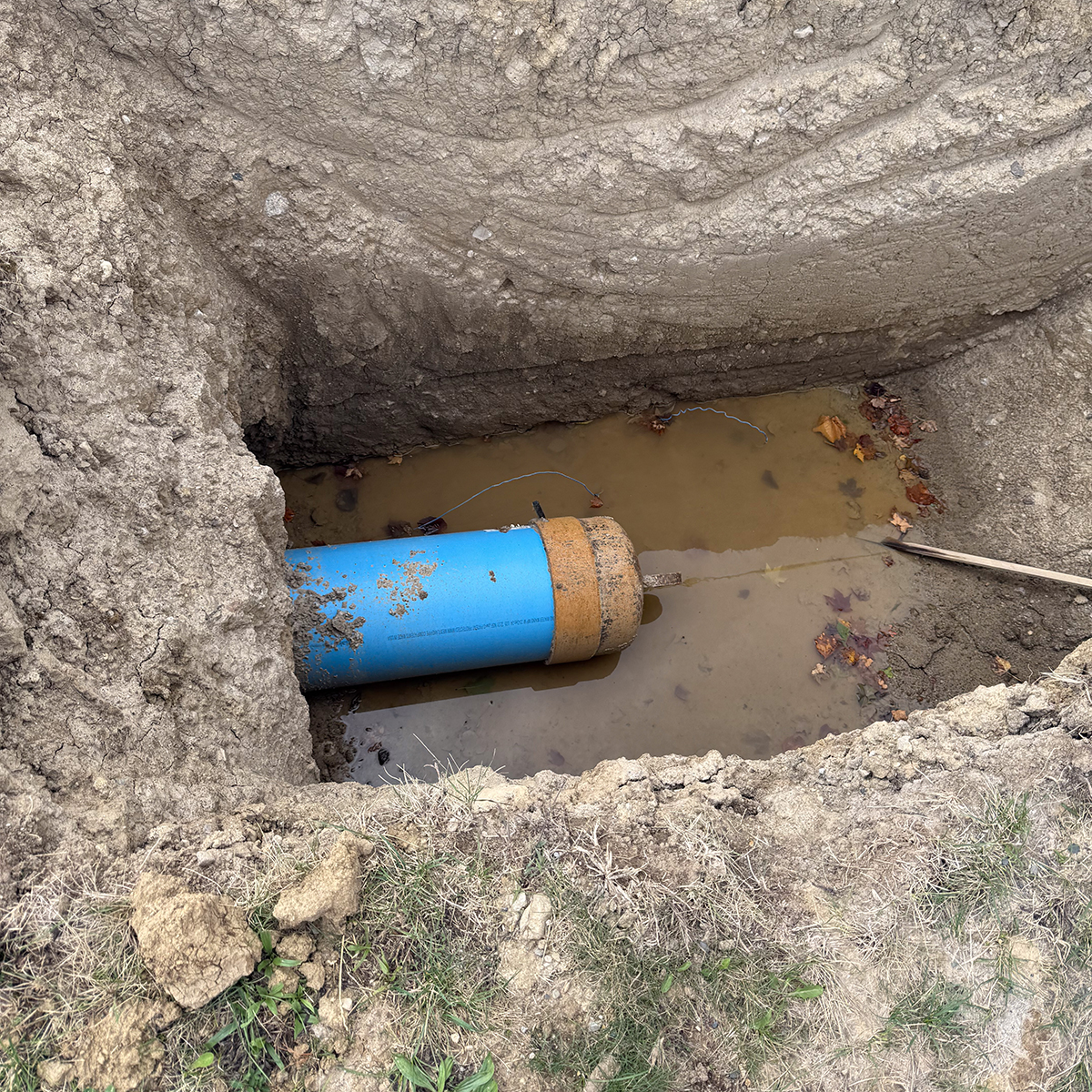
By combining C909 PVCO for long-distance, large-diameter open-cut installation with C900 Certa-Lok restrained joint pipe for trenchless crossings, the project team was able to match installation method to site conditions while maintaining consistent material performance across the system.

The integrated approach minimized environmental impact, reduced installation time, and allowed construction to progress efficiently across varied terrain—ultimately completing the project in approximately three months.

As a result, the City of Wapakoneta now has a more resilient and expandable water distribution system, capable of supporting projected demand growth from 2.4 MGD to 5.0 MGD, while improving system redundancy, fire protection, and long-term service reliability for its Industrial Park and surrounding community.