The majority of pipe, nearly 13,000 feet, was installed using the open trench method. However the biggest challenge of the project was determining the best way to run the pipeline underneath Highway 64 and a 15-foot deep creek on the other side of the road.
To minimize traffic disturbance and debris, the Revell crew employed the directional drilling method for 1,520 feet of pipe.
“There wasn’t much of a choice because the pipe needed to go underneath a state highway and a creek,” says Ken King, president of King Engineering. “Open cut was out of the question.”
The Revell crew created a 250-foot bore and a 100-foot bore using a Vermeer D33x44 directional drill with 33,000 pounds of pullback to run the pipe under the highway, drilling mostly through red clay. For the long bore, Revell Construction subcontracted to Memphis Boring & Tunneling and its larger Vermeer D80x100 directional drill with 80,000 pounds of pullback.
Memphis Boring & Tunneling made a 720-foot bore underneath the creek through hard, red sand and then backreamed it three times due to debris encountered along the way.
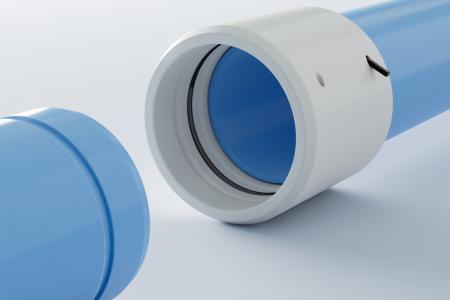
Jimmy Dodson, vice president of Memphis Boring & Tunneling, was impressed with the integrity of the restrained joint PVC pipe connected by fiberwound Certa-Lok couplings.
“The pipe held up very well during pullback,” he says. “It pulled back a lot quicker than I thought it would. It’s a good product and in the right application, you can’t find anything to beat it.”
Memphis Boring & Tunneling finished its portion of the project in ten days after which Revell Construction completed the remaining pipe installations and connections. Once operational, the new transmission line with its eight-inch pipeline created capacity for 950 more customers.
“The new pipeline allows Oakland to continue providing quality service to the growing western part of rural Fayette County, just as they have since we installed their first transmission line,” King added.