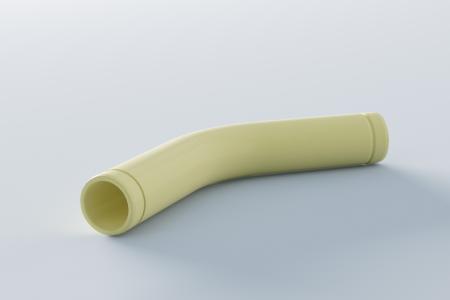
Mainline Contracting used a CAT 320B excavator to dig a trench for the PVC pipeline. The crew laid the pipe in the open trench assembling it in 20-foot lengths as they went along.
“We were able to easily assemble the pipe on the ground and lay it in the trench,” says Huber. “That helped the installation run more smoothly.”
A 160-foot portion of the pipeline was installed via trenchless method to minimize traffic disturbance as the pipeline passed under South Dakota Highway 16, better known as Mount Rushmore Road.
Beka Ditching of Rapid City was charged with directional drilling and pipe installation. Its crew created a bore through schist and silty micro clay with a Vermeer directional drill, pulling back 160 feet of eight-inch Yelomine PVC pipe to use as a bore casing. Three-inch pipe was then pulled back through the casing and open trench work continued on the opposite side of the highway. Pipe laying continued until the crew connected with the sewage pump house further up the mountain.
Huber estimated their finishing point, the sewage pump house, was 200 feet higher than their starting point. The highest point the crew reached was 5,000 feet above sea level. He adds the pipe’s spline-locked gasketed joints were critical to maintaining system integrity on such a high-slope application.
“It was basically one continuous grade uphill,” Huber said. “If you averaged it out, it would be about a seven-percent grade.”
Other obstacles included cutting through chunky soil, filled with the mountain’s hard granite, and South Dakota’s wintery weather. Since the crew started late in the year, it was forced to suspend work whenever snowfall was too heavy or temperatures were
too low.
When the sewage grinder pump arrived, all final connections for the new lift station were made.